Monday, 16 August 2010

My paternal grandmother, Lydia Jane Roberton nee Whittaker

This was my father's mother, Lydia. From what my father said, she was a kindly, hard working, religious woman. Here's what he wrote about her.

My mother was born on 4th December 1885, the only child of Thomas and Jane Whittaker, in the parish of Bonhill in the county of Dunbartonshire.
 Her father was English and from stories she told me of visits to her relations in Bradford and Chorley, I know that she was very proud of her Englsh background. However, she seemed to drift apart from those aunts and cousins she talked about with affection and she never visited them to my knowledge after she was married.
Her mother was from Kircudbrightshire and was a widow when she married my grandfather.
The great love of my mother's life was her church, St  Mungo's Episcopal, Alexandria. This was known locally as the English church. When she was born, St Mungo's was not in existence and she was confirmed in St Augustine's, Dunbarton. She and her father were among the founder members of the church in Alexandria and she worked for it in almost every capacity. She was in the choir, she was a Sunday school teacher and I remember the armfuls of flowers that came from my father's garden when it was my mother's turn to "do the flowers". My father was brought up as a Presbyterian which is the established church of Scotland, but to please my mother he joined 'her' church and was confirmed into it.
My father was in regular employment and with the garden we were never short of fresh vegetables so there was always plenty of food in the Roberton household. This, added to the fact that my mother was a superb cook, meant that mealtimes were something to be looked forward to. 

My paternal grandfather, Charles Roberton

My grandparents all died before I was born so any impression I have of them has always been based on the stories my parents told me.

This is my father's father, Charles Roberton. He was born in Jamestown, Dunbartonshire, Scotland in 1881. This is what my father wrote about him.

My father was  born on 25th March 1881 in Jamestown in the parish of Bonhill, Dunbartonshire. His parents were Thomas and Helen Roberton and he was the fourth child and third son of a family of eight.
He was educated at Jamestown school and I can remember him telling me that when he was about eleven or twelve years old he worked what was called 'half and half'. That is, he worked part of the day and went to school for the remainder of the time.
About 1907/08 he emigrated to America and stayed there for fourteen years mainly around the Detroit area, although I believe he also had a spell working as a fireman on the Trans Canadian railway.
A search of the Detroit City Directories showed the following entries for a Roberton, Chas:-
1911                                                             Boards                       875 Congress
1914             Watchman                                      "                           37 Hamtramck
1915              Machinist          Pd & Co                  "                           241 Concord
1916                   "                    "                                                   251 Meldrum
1918             Autoworker                                 Resides                      91 Avalon,
                                                                                                      Highland Park
I have a small document holder of my fathers which contains two documents (a) an Employee Pass dated 1918 for the Ford Motor Company with his photograph attached to it and (b) a Registration Certificate in my father's name with the address 94 Avalon and the date 12 Sept 1918 on it. These two documents tied my father to the directory entry for 1918 ayt 94 Avalon.
His eldest brother, Thomas also emigrated and did in fact remain permanently in America. The fact that Thomas was in Detroit at the same time as my father is confirmned by an entry from the Detroit City Directories for 1914 which records a Thomas J Roberton, a plumber, with a house at 37 Hamtramck. This is the same address as a Chas Roberton was boarding at in 1914.
My father became a naturalised American citizen on 25th September 1917. He returned to Scotland for what was to be a visit, my my mother, got married and never returned to his adopted country. His American citizenship did in fact cause a minor problem during the second world war as he had to technically register as a foreign citizen.
He did not pass an apprenticeship as all his brothers had, but obtained a position in 1922 as a labourer in what had been a large estate on the banks of Loch Lomond at Balloch. The estate had been owned by 'the Browns of Balloch' but was later taken over by the Glasgow Corporation and run as a public park. During the thirty odd years he worked there he became an excellent gardener and our own garden was ever the envy of all our neighbours.
He was not a talkative man except when discussing his garden. Our cottage was situated at a crossroads near to the back entrance of the park and the road continued up the hill to a succession of farms. On a summer evening, my father would walk up the hill to a gate about half a mile away. There he would fill his clay pipe with a strong tobacco called Thick Black, light up, and leaning on the gate spend a contemplative half hour staring down to the vale below until it was nearly dark,then he would slowly saunter back home.


Ancestry.co.uk

My father would have been in his element if this website had been around when he was alive. I've found it of immense help and guidance.

Once registered, you can use it as a free service to set up your family tree and access certain free data. A paid subscription comes in three levels and offers you a lot more information and records such as census, certain birth and death records, and telephone directories, plus access to the family trees of other registered users.

Besides your family tree, you can record details for each of your ancestors such as birth, residence, marriage etc, records (e.g. census) and photographs. I keep a file of my research and have printed out the ancestry pages that I've created for each ancestor.

Ancestry sends out regular newsletters with updates and news. Have a look at Ancestry.co.uk for more details.

Keeping a record of your own life

One thing I noticed when making notes on my father's life is that beside the stories he told and some documentation he left, there are gaps in his life where I have no idea where he was living or what he was doing. For instance, he left his home in Balloch when he was twenty years old to live in England. That would have been 1942. I have a record of him living in Blackheath in 1948 but the years in between are a mystery. I have a vague recollection of his saying that he lived in Chester or Worcester before moving to London but that's the only information I can find.

If you're like me and want to hand your family history down to your children, remember to keep a record of your own life too.

Photos of Charlie

With his parents
With Rosie, one of the working horses from the farm where his father worked
In hospital during the second world war
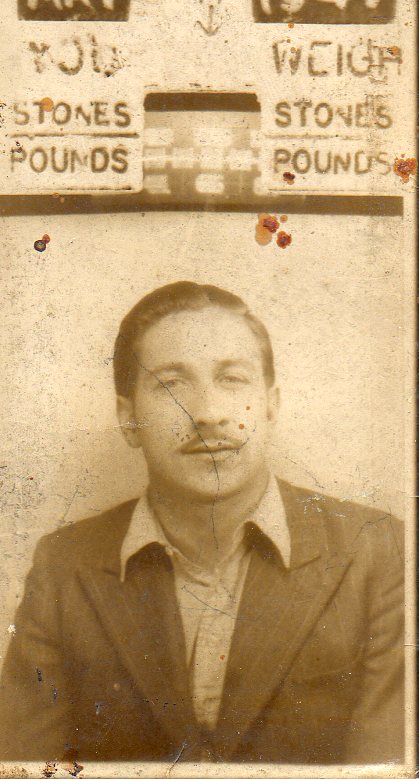
May 1947 - 24 years old

Sunday, 15 August 2010

Childhood

Another piece written by my father.

The cottage and the surrounding countryside was to be the scene of my formative years and it was here that I spent a very happy childhood. When I was five years old I started at Jamestown Primary School, the same school as my father had attended as a boy. The school was about a mile from my home and the only method of transport was by 'Shanks pony'. This was in 1927 and there were a few motor cars about at that time. In fact, they were greatly outnumbered by the horsedrawn carts. The road down to Balloch was not tarmaced, in fact it was only a track marked by two wheel grooves with grass growing in between. In the winter you could walk along these wheel grooves with a foot of snow on either side of you. There seemed to be some doubt as to the name of the road, to some people it was known as Boturich Road after the estate it eventually led to. To others it was Mollanbowie Road after the farm it passed through.
I have many happy memories of time spent in the woods and farmland surrounding my home. In particular, I spent a lot of time on Mollanbowie Farm which was situated between our house and Balloch. The farm was owned by two cousins, Jock and Aggie McNeil. She was a bossy woman while he was the quiet type except when he got drunk on Market Day or on the day of the local agriculture show. There were three other workers on the farm: the ploughman, the byreman and the maid. The latter two were engaged by the old practice of 'feeing'. This meant that the farmer went along to the Michaelmas or Martinmas fairs and engaged workers who were then tied to the farm for the next six months. The maid had a room somewhere in the main house while the byreman lived in the 'bothy'. This was a stonefloored room with merely a table and a couple of chairs and an iron bed with a straw mattress and rough blankets made of sacks. There was also a fireplace which burnt logs. The byreman looked after the cattle: fed them, mucked them out and took them to pasture in the summer. The cattle were milked by hand and I can still remember the sound of milk hitting pail as the milker squeezed the teats. Everyone helped with the milking except for the ploughman.
 Most of the cottages around got their milk directly from the farmand around milking time, late afternoon, you could see the ladies arrive with their tin jugs to collect their milk for the day. This daily journey gave them a good opportunity for a 'blether', the Scottish term for a good, old gossip.
The ploughman looked after the horses and the crops and was, in fact, the farm foreman. The ploughman at Mollanbowie was Jimmy Hobson whoh was a close family friend of ours. He did not live at the farm but instead lived with his mother who was a lovely, gentle old lady withg a soft Highland accent. His father had worked in the public park with my own father but had died when I was only about six or seven years old.

First Beginnings

This was written by my father. 
I was born on 4th October 1922 at 16 The Crescent, Alexandria, Dunbartonshire. My parents were Charles and Lydia Jane Roberton. My mother's name was Whittaker, hence my middle name.

Alexandria is in the Vale of Leven which is situated between the town of Dumbarton and Loch Lomond. The vale takes its name from thefast flowing River Leven which flows from the fresh water Loch Lomond at Balloch and takes a very winding course until it flows into the River Clyde at Dumbarton.
I was born in a terraced house on the banks of the Leven near to where a road bridge called the Bonhill Bridge connected the parishes of Bonhill and Jamestown to Alexandria. This was probably an appropriate spot for me to spend my early years as my father was born in Jamestown and my mother in Bonhill.
As we left his house when I was only four years old, I have few clear memories of it and those I do recall are linked more to stories told and often retold by my father, than to actual memries of my own making. In particular, my father loved to recount the visit he had from a new sergeant of the local police nicknamed 'Chesty' who advised him that some lads had been seen removing railway sleepers from the nearby railway station and that my name had been given as one of those involved. As I was only three years old at the time the affair gave my father a great deal of amusement and no doubt caused the unfortuate sergeant a similar amount of embarrassment.
My only other source of information was from listening to the stories told at family get-togethers after we had left Alexandria. It was the practice in those days for close relations to visit each other periodically. There would be a high tea with boiled ham and a cake-stand full of home-made cakes and scones. After the meal we all sat in the 'front room' where the adults had a good old chinwag, the children being 'seen but not heard'.
 Our closest friends and relations were Willie and Jean Bennie and their children, Mary and Peter. Jean Bennie was in fact the daughter of my mother's stepsister althought they had been brought up as sisters.
At such a meeting, the two of them would go through the same routine of discussing all the local gossip, old and new, about the people they had known. At the end Willie Bennie would turn to my father and say "Well, Charlie, that's the Crescent put to rest 'til the next time".